Tuesday, December 10, 2013

Entertainment and education

So as a political scientist, I understand there are a number of ways that civil discourse or protest or political speech can exist in the public domain. For centuries, music has been one way of expressing dissatisfaction with an oppressive regime. And now a student has ventured into the storied domain of resistance music. For your entertainment and edification I humbly present the following.


I would invite those more learned than me to weigh in on the specifics of this form of expression.

The Flim Flam Man, His Administrative Clown Show and the "Big Con" at Chicago State

In just the past four weeks, Wayne Watson’s Chicago State administration has increased its output of lies, misrepresentations and cynical distortions.

On November 11, Patrick Cage, the university’s lead counsel (and suddenly another Vice President) sent out the now infamous “cease and desist” order citing trademark infringement as a rationale for ordering the faculty voice blog “disabled.” At the time of Cage’s letter guess how many registered trademarks the university held? None would be the correct answer. On December 2, the university responded to a FOIA request for trademark numbers. An examination of the material sent by the university reveals that Chicago State applied for three trademarks on November 14, 2013, three days after Cage’s communication. Anyone interested in following the progress of these applications (one has already been voided because CSU failed to meet minimum filing requirements), can go to the US Patent and Trademark website (http://www.uspto.gov/trademarks/process/search/) and look up application numbers 86119380 and 86119007. The misfiled application was 86119147.Here is a portion of one of the applications that displays the application date of November 14, 2013:


Around the same time, we found out through the Chicago State Marketing and Communications folks that our wonderful president had received two prestigious awards in November 2013. First, he had been elected Chairman of the Board of the National Association of Equal Opportunity in Higher Education (NAFEO), second, he had received the Educational Leadership Award from the Thurgood Marshall College Fund. It seems like the administration and its mouthpieces want the rubes to believe that these awards somehow mitigate the myriad failures of the Watson administration.

Not surprisingly, given the performance of our flim flam president and his clown show administration, these announcements were not entirely truthful. Watson had been elected as the NAFEO Board Chairman several months earlier, perhaps as long ago as January or February of this year. This link to an announcement of NAFEO’s upcoming conference on April 14-17, 2013 shows Watson as the Board Chair-Elect: http://www.nafeo.org/dialogue/. As a point of interest, Watson’s predecessor as NAFEO Board Chair, President Ernest McNealey of Stillman College, was abruptly placed on administrative leave by his school in early September and subsequently resigned his position as the college’s president on December 3. http://www.tuscaloosanews.com/article/20130910/NEWS/130909761
http://www.tuscaloosanews.com/article/20131203/news/131209963

In a similar vein, Watson’s award from the Thurgood Marshall Fund is not exactly what it seems. He originally won the award in 2012 and was to receive it at the fund’s twenty-fifth gala. However, Hurricane Sandy forced the cancellation of the event. Instead, the twenty-fifty gala occurred in 2013 and all of the major award recipients from 2012 received their awards in 2013. While Watson indeed received the award, the recent announcement gave the impression that it was a recent honor, rather than something more than a year old. Here is the 2012 announcement from the Thurgood Marshall website: http://www.thurgoodmarshallfund.net/press/the-thurgood-marshall-college-fund-honors-education-pioneer-wayne-d-watson-at-25th-anniversary-awards-gala. Anyone taking the time to compare the 2012 announcement with the 2013 university press release will note the similarities, including the theme: “Developing Minds and Delivering Dreams.”

On December 3, 2013, the interim provost claimed that she had never referred to the “invalidity” of the Chicago State Faculty Senate. However, her memorandum of October 31, 2013 to the faculty senate and subsequently the entire university faculty renders her December 3 assertion untrue. Here is the significant paragraph from the provost’s memorandum:


That sounds to me like the provost is talking about the senate's "invalidity."

All these falsehoods are part of the big con that Watson and his minions are running on the students, staff, faculty, alumni and other administrators at Chicago State as well as on the citizens and taxpayers of the state of Illinois. We have an upper administration populated with persons who have falsified their educational or experiential credentials. We have an administration that consistently fails to follow its own policies and procedures while paradoxically being interested in the activities of other university bodies--particularly those bodies that have been or are critical of the president and his administrators. We have a president who cannot even begin to solve the various problems that beset the university but who garners personal awards which can cynically be used in a public relations effort to offset criticism of his activities. Should we next expect an announcement that some political ally of Watson has contributed money to the school?

In the past four years, the Watson administration has proven itself to be venal, incompetent and arrogant. This rancid administration has inflicted severe damage on Chicago State University and will continue to do so as long as it retains its control over the school. In a subsequent post, I will detail the lengths to which Watson will go to retain his "power."

Monday, December 9, 2013

Mandela's legacy and racism at Chicago State--a communist view


I would like to offer few words about Mandela’s legacy and the lessons of that legacy for the struggle against racism at Chicago State.

My political development was partly honed in the anti-apartheid struggles of the 1970s. I recall organizing a rally at the University of Missouri—St. Louis comparing the anti-black violence occurring then in Boston (against racial integration of schools) with the violence in South Africa. Several times we showed the film Last Grave at Dimbaza, which made graphic the costs of the racist social and economic system, the high infant mortality, pervasive child hunger, slave-like conditions for miners in the great extractive industries of gold and diamonds, for black domestic servants, and for black workers in factories, the vicious apartheid laws—pass laws, homelands, identification checks—and white rule imposed to keep black workers down. In 1976 I was arrested along with three or four others as we tried to take an elevator to a Merrill-Lynch office to protest the sale of Krugerrand gold coins, used to fund the South African government. But the struggle against racism in South Africa was being led by South African children and youth, chanting “Liberation before Education,” leaving their classrooms to march in the streets against apartheid, refusing to be intimidated by police attacks. The townships, Soweto being the leading one, were centers of militancy, as police informants were “necklaced,” not a pleasant way to die.

In this context of mass struggle eventually Nelson Mandela was released from prison after 27 years and led the African National Congress to power as the racist apartheid system, pass laws, and racial “homelands” were abolished. Now, with his death, he is being hailed around the world as a hero—by the capitalist press and other media. Why do the capitalists love Mandela so?

First, the transition from apartheid and white rule to a government elected with African suffrage was made peacefully. The struggle in the streets was replaced by political maneuvering and the ballot box.

Second, and most important, the control of the South African economy by corporations based in Britain, elsewhere in Europe, and the United States was maintained and expanded. Wealth from gold and diamonds still flowed into the capitalists’ coffers. Cars, steel, and other goods were manufactured profitably with black (and some white and “colored”) labor. The economy expanded under Mandela’s pro-business policies, and foreign investment increased.

Third, the social control of black labor was achieved more effectively and with less resistance when the visible political ruling class was composed of black Africans. A small African elite was allowed to prosper and share in the capitalists’ wealth. A somewhat larger African middle class was sustained. The vast majority of black workers toiled in extreme poverty. Along with Brazil South Africa today harbors the most extreme economic inequality.

Still, resistance continued. Workers are not easily denied. In 2012 miners at Marikana wildcatted. The response was violent suppression, leading to the deaths of at least 44 miners and shooting injuries to many others. Most were shot in the back. Many other South African miners went on strike.

So Mandela’s legacy is a racist South Africa where black miners and other workers still are violently suppressed to insure the capitalists’ profits. Still, the protests against these racist injustices are more muted than they were when the faces behind the guns killing black people were white. There is a lesson to be learned here, to fight racism regardless of the color of the face of the racist oppressor.

We experience racism at Chicago State as a thousand small slights, not mass shootings. Many things are inferior; these are racist conditions experienced by our students, mostly black: long lines for financial aid and at the bookstore, lost paperwork in the Cook building, chalkboards and whiteboards that have not been cleaned or maintained, broken concrete and stairs, bathrooms in need of repair. The need to focus on the racism of the oppression not the color of the oppressor applies to the struggle against the bookstore policy of excluding CSU students from the textbook aisles. The struggle against racism continues. Only ending capitalism and replacing it with a society run by and for the working class—communism—can end racism once and for all.

Tuesday, December 3, 2013

The Response

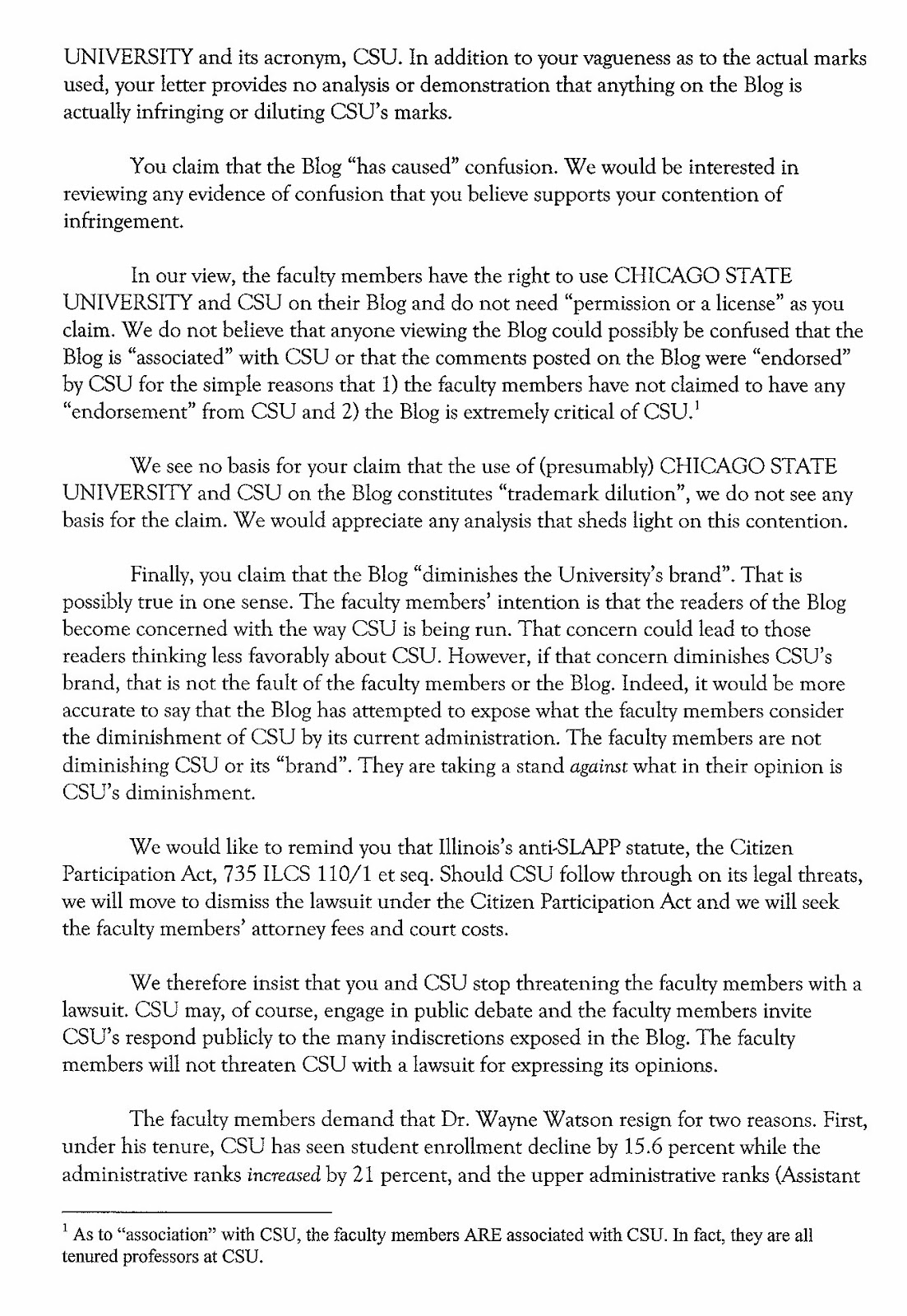
So loyal readers, your humble narrator was forced by the circumstances of that most distasteful "cease and desist" letter to seek legal counsel to address the most unpleasant assault on our First Amendment rights. Joined by my fellow bloggers, The Crony State Eight, we sought the guidance of some very capable attorneys who advised us to continue blogging and let them handle the official response to the university. Below is the letter to the Vice President and General Counsel from our attorneys at Goodman, Tovrov, Hardy & Johnson, LLC. I believe their short missive speaks volumes about this situation. 


This I can assure you loyal readers, the threats of a failed administration hold no sway over my colleagues or me and should continued legal intimidation ensue, I would imagine more embarrassment for the regime.

Monday, December 2, 2013

This is What "Transparency" for Chicago State Students Looks Like Under This Execrable Regime

In the Orwellian world of Chicago State University, Wayne Watson's constant bloviating about "transparency" has become an almost comedic trope. As Paul points out in his previous post, the Watson administration, apparently so concerned about appropriate "process" as practiced by every other university constituency, consistently fails to apply those same stringent criteria to itself. This year's student elections are a prime case in point and offer a glimpse at two things that have been constants during this seemingly never-ending administration: 1) the ethically questionable, even corrupt practices of this administration are not limited to the university's faculty; 2) the administration does everything possible to prevent its activities being exposed to the light of day. This includes stonewalling legitimate FOIA requests, by either failing to respond or by offering ludicrous rationales for failing to respond (for examples see Public Access Counselor opinion 13-009, available here: http://foia.ilattorneygeneral.net/2013binding.aspx, or the most extreme case, opinion 12-003, available here: http://foia.ilattorneygeneral.net/2012binding.aspx).

Following the administration's refusal to accept the results of the May 2013 SGA election, it resisted the effort by the aggrieved parties, Willie Preston and Brittany Bailey, to discover the actual results of the election. Following a legitimate FOIA request by Preston, the administration failed to respond and the matter ultimately had to be resolved by the Illinois Public Access Counselor. Preston made the original request for the election results under the Illinois Freedom of Information Act on May 7, 2013. Due to the administration's failure to respond, it was necessary for Preston to appeal to the Illinois Public Access Counselor who, on October 24, 2013, ordered Chicago State to release the results. Ultimately, Preston received the records on October 30, 2013. The following are excerpts from the Public Access Counselor's letter to Chicago State:


Based on the overwhelming victories achieved by both Preston and Bailey, both running (according to Preston) on a platform that included a proposed motion for the removal of Wayne Watson, it seems obvious why the administration tampered with the election results:


So this is what Watson's vaunted transparency means. If the administration does not get the result it wants from something as seemingly innocuous as a student election, it will simply set the result aside and hold elections until it achieves the desired result. Then, when called to account, it will make a ham-handed attempt to cover its tracks. Democracy and the wishes of the school's students be damned!

As a point of information, I am currently awaiting the results of an appeal to the Illinois Public Access Counselor for a FOIA request I made on November 7, 2013. This administration truly has no desire to see its operations exposed to public scrutiny. Also, all the material posted here is made public with the permission of Willie Preston.

SGA elections, real and bogus


In the spring of 2013 a Student Government Association (SGA) election was held to select an SGA President, Vice President, student representative to the Board of Trustees, Secretary, and Senators. This was the last SGA election held under the SGA constitution and by-laws. In that election Brittany Bailey was elected president by a margin of 292 votes to 80 for the other candidate. Willie Preston was elected student representative to the Board of Trustees with 236 votes; the other two candidates received 37 and 88 votes.

The administration voided the election. (Preston got the results under a Freedom of Information Act request.) Then Preston was suspended from the university for the fall semester. Subsequently he has been expelled from the university. I invite others who have more information about these disciplinary actions to post them on the blog.

This fall an “SGA election” was held. A “Board of Elections” was set up to administer the elections. (I use scare-quotes because the Board of Elections is a body under SGA by-laws, and this “Board of Elections” did not operate under these by-laws.) Brittany Bailey ran for student representative to the Board of Trustees. Eventually she was “disqualified” under the “election rules” of the “Board of Elections.” As far as I can tell her disqualification was illegal. Like Willie Preston, she is simply someone the administration did not want to hold the position of student rep to the BOT.

At the time of the fall “SGA election” the only operative constitution and by-laws were those for 2012-2013 since they had not been superseded by later documents. I have looked over the SGA constitution and by-laws and tried to study the Elections Policy, which is part of the SGA by-laws, more carefully. I have reached the following conclusions.

1.      The “Board of Elections” had no authority to make additional election rules besides those contained in the SGA by-laws Elections Policy.

2.      There is no prohibition of non-students campaigning for a candidate.

3.      There is no prohibition of campaigning in classrooms.

4.      There is no prescribed sanction for distribution of fliers which have not been stamped, only for POSTING unapproved fliers or posters.

5.      The BOE has no authority to issue sanctions for actions which are not violations of the Elections Policy.

As far as I can tell the “BOE” had no authority under the SGA Constitution and by-laws, specifically the Elections Policy, to strike Brittany Bailey’s name from the ballot for any of the alleged violations, none of which is a violation of SGA Elections Policy.

When the “Board of Elections” met with Students for Justice, I was told that the chair of that group, claimed that they were not operating under the SGA constitution. But if so, they had no authority to hold an SGA election, since that can only be legitimately held under the SGA constitution.

More recently, there was a disciplinary hearing for Brittany Bailey. I invite others to fill in more details here.

In summary: Brittany Bailey and Willie Preston were elected in the spring SGA election, which the administration voided. Preston was suspended and then expelled. Then a bogus “election” was held in the fall; Bailey was disqualified for actions which are not prohibited in SGA elections policy. Then a disciplinary hearing was convened for her.

Wednesday, November 27, 2013

The Real Story at CSU


The endless stream of embarassment brought to CSU by administrative incompetence and feeble attempts at bullying faculty, students and staff has made our campus a laughingstock around the country and places beyond.  For this reason alone (not to mention their numerous failures) Wayne, Patrick, Angela and the many others who have received their cushy admin jobs without proper qualifications, with falsified resumes or as a result of personal relationships with someone in power should resign as soon as possible.  They should do the decent thing and quit before the damage they do is irreversible.


But, that is not the point of this post.  The point of this post is to remind us of the work that gets done on this campus on a daily basis in spite of the roadblocks erected by our administration.  Recently, I have had the pleasure to see my colleagues and our students in action and it reminded me why I am an academic and a scholar and renewed my faith in our profession and our students. I have been witness to or made aware of a number of events resulting from the great professor-student interactions and collaborations that go on regulary at CSU.  They include:


Blues for an Alabama Sky, Pearl Cleage’s esteemed play set during the Harlem Renaissance, was performed well by students under the direction of Professor Kamesha Khan.  We have a great deal of artistic talent at Chi State.  Recent performance and media industry excellence coming from our campus includes the CSU Jazz concert held on November 26 and the continuous work on the popular radio station, WBEZ, of CSU students and faculty including Herb Kent and Troi Tyler.  CSU boasts a number of very well respected and award-winning authors who produce poetry, short stories and essays.  In addition, these authors are training an enthusiastic and talented group of younger writers.


Community work that involves students, faculty and other members of the CSU campus is ongoing here.  The Neighborhood Assistance Center (NAC) and the Institute for Youth and Community Empowerment (IYCE) have made their presence felt in our community in recent weeks, months and years.  The NAC has had a long presence in Chicago assisting neighborhood organizations access the resources they need to do their work.  In recent years, the NAC has focused a great deal of energy on questions regarding food and hunger in the Chicagoland area.  The NAC supports an urban agriculture network in the Roseland-Pullman area, works with the Chicago Food Policy Advisory Council and has helped establish the new Urban Agriculture concentration in the biology and geography departments.  IYCE has recently begun to make itself known on campus through important dialogues and other programming relating to their mission of empowerment of the communities surrounding CSU.  Their Truth-N-Trauma project has begun to develop younger students and help many on the road to positively dealing with trauma in their lives and in our larger world.  A number of departments, programs and centers have developed important scholarly events open to the entire campus and reaching out to the larger Chicago community.  Students, faculty and staff held a successful Coming Out Day this Fall that included activist and recording artist Tim’m West in an effort to help LBGTQ members of our community cope with homophobia and to enlarge our sense of community.  African American Studies seems to always be putting on important educational events such as the most recent discussion of Kari Lydersen’s timely book, Mayor 1%.  The geographers do a lot with a small program including the just completed, Geography Week, with educational programming including discussions of powerful movies such as The Rise of the Drones and The Agronomist.

Our faculty and students conduct a great deal of scientific research.  The biology, chemistry and physics labs are overflowing with professors leading students in exciting new areas of research including health breakthroughs, energy development, and environmental sustainability.  The centrality of the professor-student relationship is illustrated well by the work being conducted in our labs.  Related to the scientific research being conducted in the sciences building is the work of many in public health and occupational therapy.  Public health students and faculty regularly sponsor or participate in health fairs and screenings, workshops and discussions regarding public health problems and the development of solutions.  Faculty, students and staff at the HIV/AIDS Research and Policy Institute continue to conduct groundbreaking research into understanding HIV/AIDS, its spread and how to prevent it.  Particularly important is the culturally-relevant materials and programs being developed through the institute.

While I have had the good fortune to witness the incredible intellectual work being conducted at CSU by many colleagues, I have only scratched the surface as I know that many in the College of Ed and College of Business, for example, are also contributing positively to knowledge and to our communities.  I only hope to learn more about this work.  In addition to local events and research like those previously mentioned, our colleagues publish books, articles and music scores, contribute to professional organizations, work as public intellectuals, and assist myriad non-profits and community groups.  And we do this all while teaching 4 or 5 classes per semester and doing the nuts and bolts work of maintaining the intellectual integrity of the university through our committee work.

The previously mentioned work illustrates the importance that we place on the professor-student relationship in higher education.  It is not just a job.  It is a vocation.  It is a calling.  We do it because we know that it is important.  At CSU, like other institutions of higher education in the US and around the world, the primary work is to educate.  Thus, the student-professor bond is the key to our success.  At CSU we take the student-professor relationship very seriously and as a result the bond is strong.  So, while negative press and scandal have plagued CSU, all of it has been as a result of administrative incompetence, retaliation and a lack of professional ethics and integrity.  The teaching and learning at Chi State rival most institutions of higher education.  And this under the most difficult of conditions including the remarkably busy lives of our students and the continuous failures and misdeeds of the upper administration.  It is the sacred bond between faculty and students and the work that this produces that is the real story at CSU.

Saturday, November 23, 2013

A Pattern Developing????

So it seems that our university continues to struggle in the area of human resources. No loyal readers, it isn’t the falsified job applications and resumes of  administrators. This time it is the management of the Civil Service employees. In accordance with the State Universities Civil Service Act, the university is audited biennially to ensure compliance with the provisions of the Act. In the 2009 report, the university had three findings with one repeat finding from the previous audit. The 2011 report, the first under the current administration, revealed nine findings with four repeat findings. This threefold increase mirrored the audit findings for the university at large with audit findings increasing from 13 to 41. A reasonable person might expect some improvement and lo and behold the 2013 audit report revealed an improvement.  The most recent audit report, dated October 3rd, 2013, shows the university had only seven findings with five repeat findings. Numbers are just numbers though. Without context, they have no meaning. So let’s put these numbers into a context. Since 2008 University of Illinois at Chicago has received 18 audit findings with 16 repeats. Illinois State University has received 19 audit findings with 12 repeats. Six state universities received single digit total findings over multiple audits. Of the six non-university agencies covered by the State Universities Civil Service Act there were four audit findings with three repeats covering 15 audits since 2008. Four of those six agencies received no findings since 2008. Therefore, I would have to ask how a university with one of  the smallest number of employees covered by the civil service laws and regulations could be in the top three of audit findings since 2008. CSU had nearly 20% of the audit findings statewide while only having 3% of the enrollment of state public universities. Clearly, CSU should not have as many findings over time as it has. 
What could possibly be the reason for this substandard performance in the area of human resources? Could those reasons be related to the previously documented activities around falsified applications? 

And it is official. The attempt to silence this Blog has received international attention. From London (England, not Ontario) Times Higher Education has a brief entry. Is CSU now officially an international laughingstock?

Thursday, November 21, 2013

Clumsiness and Cowardice in the Cook Building

The most recent attempt by our administration to crush dissent at Chicago State seems to have been rather poorly conceived. One caustic article concludes with this paragraph:

“Obviously the school and its lead counsel habitually attempt to stifle criticism. Of course, each attempted shutdown usually results in more critical speech. Not only are its actions counterproductive, they're counter-intuitive. Rather than let criticism flow by, indistinguishable from the millions of other angry voices flowing across the internet, the school has called attention to this blog, upping its readership and further spreading the negative portrayal of the school and its administration. And it's done it in the clumsiest, most cowardly fashion -- by wielding intellectual property as a weapon.”

Quote taken from Tim Cushing “University With History of Free Speech Violations Abuses Trademark Law in Clumsy Attempt to Shut Down Critical Blog” available here : http://www.techdirt.com/articles/20131112/14585725219/university-with-history-free-speech-violations-abuses-trademark-law-clumsy-attempt-to-shut-down-critical-blog.shtml

Let’s just call this whole uproar over faculty “incivility” what it is: another attempt by Wayne Watson and Chicago State's administration to stifle dissent. Wayne Watson and his administrative flunkies are unable to refute the fact-based substance of the posts on this blog. Thus, they must resort to a cynical three-pronged defense strategy: threaten their critics with legal action for "trademark infringement," imply that discipline could result for their critics because of their violation of "the University's policies requiring civility and professionalism of all university faculty members," and caution members of the university community not "to air our dirty linen in public." Given the numerous examples of the uncivil behavior displayed by the Watson administration over the past four years, Watson's current concerns about faculty incivility likely stem from simple self-preservation. If no one looks into his behavior, if no one exposes it publicly, he can continue to abuse various university policies and degrade the university's academic reputation with impunity.

An instructive example of how Watson behaves when he faces sustainable allegations of misconduct occurred in February and March 2013, during the struggle over his potential dismissal as Chicago State's president. In the late February draft of a letter he ultimately sent to the Board of Trustees, Watson creates a world in which he is the victim, in which a number of persons are conspiring against him, and in which any kind of attacks against his opponents are appropriate. Watson's letter mixes innuendo, lies and obsequity into a set of accusations that appear in a document that should be beneath the dignity of anyone serving as the president of a university. However, his letter provides an example of the incivility and intellectual and ethical bankruptcy of its author.

At that time, Watson was desperately fighting to keep his job. Cowering behind his attorney, Emil Jones and his political allies, Watson sent a letter to the board detailing a number of unsubstantiated charges against those he considered his primary enemies: Gary Rozier, Chairman of the Board of Trustees, “Z” Scott, Vice-Chairman of the Board, Sandra Westbrooks, then Provost and the interim president named to succeed Watson, and Faculty Senate President Phillip Beverly.

Watson was under fire for, among other things, an improper relationship with another university employee, Cheri Sidney; an employee for whom Watson could and did make decisions regarding her hiring, salary and advancement. This relationship violates Chicago State policy as the university's Human Resources Policy Manual clearly indicates:


Wayne Watson begins his letter with a discussion of his improper relationship. His first two paragraphs miss the entire point of the Chicago State policy as he invokes the first amendment as affording him the right to associate with anyone he chooses. Of course, no one cares about his relationships, the only concern is the impropriety of giving highly-paid administrative positions to your friends. Documents previously posted on this blog contradict Watson's self-serving claim that "no employee has received any unearned benefits based on their friendship with me."


His next paragraph provides an overview of his primary strategy: attack the persons he perceives as most responsible for his predicament. Watson notes that Patrick Cage is in possession of information the board needs to know:


Watson then commences his attack on Gary Rozier and "Z" Scott by offering allegations based on e-mails which are not included with the letter in my possession. Because these are unsubstantiated allegations, the following excerpts have the names of persons still working at Chicago State redacted.


Watson then moves on to his charges against then Provost Sandra Westbrooks (these are doubtful accusations and the most incendiary allegation is reacted):


This is nothing more than a parade of cynical, self-serving accusations. In fact, the Provost's Office is not responsible for financial aid, Watson's friends in Enrollment Management are. What did Watson do when he discovered Westbrook's "improper actions"? By his own admission, he covered them up. He allowed Wesbrooks to continue in her position until the conclusion of "a critical re-accreditation process." Of course, Watson neglected to mention the 20 percent salary increase he bestowed upon Westbrooks in late 2012, several months before he decided she was "conspiring" against him.

However, Watson saves his most virulent invective for Faculty Senate President Phillip Beverly. The passage speaks for itself and I have again redacted the most problematic (and totally unsupported) accusations made by Watson:


Although Watson claimed the existence of an ongoing "investigation," no one from the university ever contacted Beverly about any of Watson's allegations. Who did this investigation? While the university does not seem to have a blanket policy on personnel investigations, its policy on EEO complaints includes an early notification of the alleged offender of the nature of the charges and protects the subject's due process rights. In the case of Phillip Beverly, however, Wayne Watson apparently feels that following any kind of procedure is unnecessary. This raises the question of whether this investigation is still ongoing some eight months later.

Ultimately, Watson determined that each of the four persons he attacked had ulterior motives for wanting him removed as president. For Rozier and Scott, they desired to ensure that their friends and associates could obtain jobs at Chicago State. Of course, in Wayne Watson's fanciful account, he staunchly resisted this attempt to use Chicago State as a patronage dumping round. Westbrooks was simply angling for his job and Beverly wanted to stop administrative inquiries into his improper behavior, while at the same time strong-arming 28 weak-minded members of the Faculty Senate into a no-confidence vote against Watson. In order to make this ridiculous assertion, Watson had to resort to the bald-faced lie that "some" of the 28 faculty had "been denied tenure."

Rather than attempt to make his case for retention as Chicago State's president on its merits, Watson resorted to conspiratorial thinking, hiding behind his representatives, depending upon one of his political patrons to gin up support for his presidency, personal attacks on the integrity of several persons and outright lies as rationales for continuing as the "leader" of this institution.

Tuesday, November 19, 2013

Let's Have a Contest!

So loyal readers, you may have noticed an aesthetic change to the site. Yes, we changed the picture from the shrubbery that had adorned our blog for the past four and half years. After receiving many comments about missing the old, I decided that have old and new on the same site. You will see two of the choices in our newly announced CSU Faculty Voice Graphics Contest. Yes, loyal readers, you will be able to vote for your favorite graphic that will adorn our humble site. Our first two choices are below.

Number 1:


Number 2:


The voting on these first two contestants will close on Thursday at 5PM